
The International Maritime Organization (IMO) has adopted significant amendments to the International Code for the Safe Carriage of Grain in Bulk through IMO Resolution MSC.552(108), which will be applicable to both new and existing ships. The amendments introduce a new optional loading condition intended to improve operational flexibility while maintaining the safety standards associated with grain transportation in bulk.
For shipowners, operators, and technical managers, these amendments present both an opportunity and a compliance challenge that requires timely preparation.
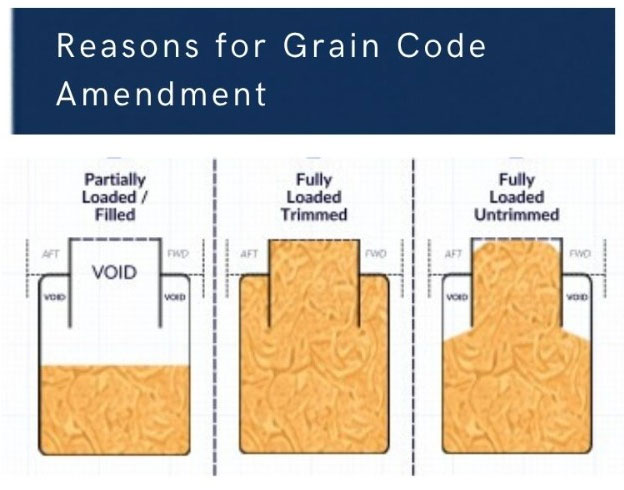
The current Grain Code recognises only three loading conditions:
However, practical grain loading operations frequently encounter situations that are not adequately covered by these conditions. Operators often face challenges such as:
These operational realities have led to situations where vessels load grain in configurations that were not explicitly recognised by the existing Grain Code, creating uncertainty in stability calculations and approval processes.
The 2026 amendments introduce a new recognised loading condition:
"A specially suitable compartment, partly filled in way of the hatch opening, with ends untrimmed."
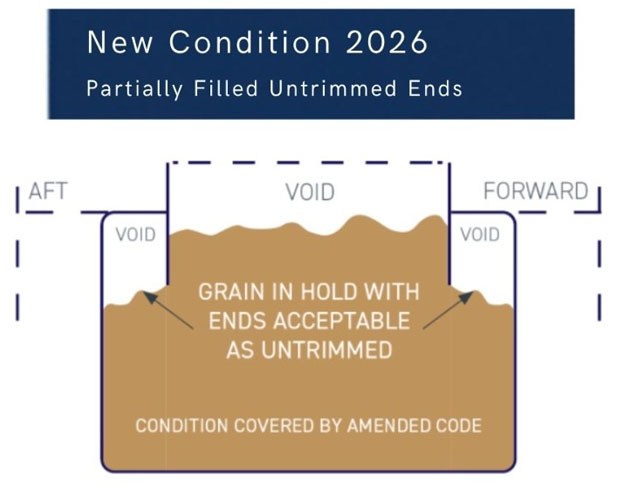
The new amendment adds a fourth loading condition: Specially suitable compartment, partly filled in way of the hatch opening, with ends untrimmed.
This loading scenario is familiar to most grain operators and has been encountered in practice for many years. However, until now, there was no clearly codified methodology within the Grain Code to assess the associated heeling moments and stability implications.
The amendment formally:
By incorporating this loading condition into the Grain Code, the IMO has aligned regulatory requirements with practical loading operations encountered by bulk carrier fleets.
If operators intend to utilise this newly recognised loading condition, several updates will become necessary:
The existing Grain Stability Manual will need to be revised to include the new loading condition and submitted for approval by the Classification Society.
The new loading condition requires revised calculations in accordance with the methodology prescribed under IMO Resolution MSC.552(108).
Where onboard loading computers or loadicators are used, the software calculations must be reviewed and aligned with the approved Grain Loading Manual.
New departure and arrival loading conditions may need to be developed and incorporated into the approved documentation.
Importantly, existing approved trimmed and filled loading arrangements remain valid. However, vessels intending to use the new loading condition must have the necessary documentation and approvals in place before implementation.
At Ocean Tech Solutions (OTS), we understand both the regulatory requirements and the practical challenges faced by bulk carrier operators in implementing the 2026 Grain Code amendments. Our multidisciplinary marine engineering team provides end-to-end support to ensure timely and cost-eƯective compliance.
Our services include:
Detailed assessment of vessel grain loading arrangements and applicability of the new loading condition.
Preparation and updating of Grain Loading Stability Manuals in accordance with IMO Resolution MSC.552(108) requirements.
Development and verification of stability calculations for the newly recognised loading condition.
Review and verification of onboard software calculations to ensure alignment with approved methodologies.
Comprehensive assessment of vessel documentation and identification of gaps to achieve compliance before 1 January 2026.
Preparation of complete Class submission packages and direct coordination with Classification Societies until final approval is obtained.
Support for operators with multiple vessels by standardising engineering updates and streamlining the approval process across the fleet.
Ocean Tech Solutions is already supporting shipowners and operators in assessing compliance requirements, updating grain stability documentation, verifying loading software, and obtaining timely Class approvals.
By acting now, operators can ensure uninterrupted trading capability, maintain compliance, and take advantage of the operational flexibility introduced by the new Grain Code amendments. Ocean Tech Solutions is ready to help you navigate the changes and achieve compliance with confidence.